



K-Food Blossoms in the Dubai Desert: From K-Halal Expansion to Food Security Cooperation
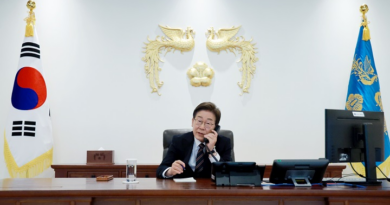
Song Mi-ryung, Minister of Agriculture, Food and Rural Affairs (MAFRA), met with the Minister of Climate Change and Environment of the United Arab Emirates (UAE) on Wednesday, January 28, in Dubai to discuss bilateral cooperation on food security. During her visit, Minister Song also engaged with Korean food exporters as well as local influencers and consumers to expand the reach of K-halal food into the Middle East and Africa, using the UAE as a strategic hub.
Discussions with the UAE Minister on Cooperation for Food Security
Minister Song met with Amna bint Abdullah Al Dahak, UAE Minister of Climate Change and Environment, where the two sides shared a common understanding of the importance of food security. To further strengthen practical bilateral cooperation in this area, Minister Song proposed the renewal of a memorandum of understanding (MOU) between the two countries.
As part of concrete cooperation measures in agricultural technology, Minister Song suggested applying Korea’s “Smart Farm Innovation Valley” model in a way that is adapted to the UAE’s climate. The two countries also agreed to work together to overcome food security challenges caused by climate change through joint research between agricultural research institutes and the sharing of genetic resource information.
In addition, Minister Song emphasized the need for cooperation in the halal food sector—including halal certification—to facilitate the further expansion of K-food into the Middle Eastern market via the UAE. She requested the UAE’s cooperation to ensure swift procedures when domestic Korean certification bodies apply for mutual recognition.
Encouraging Korean Exporters Participating in Gulfood 2026
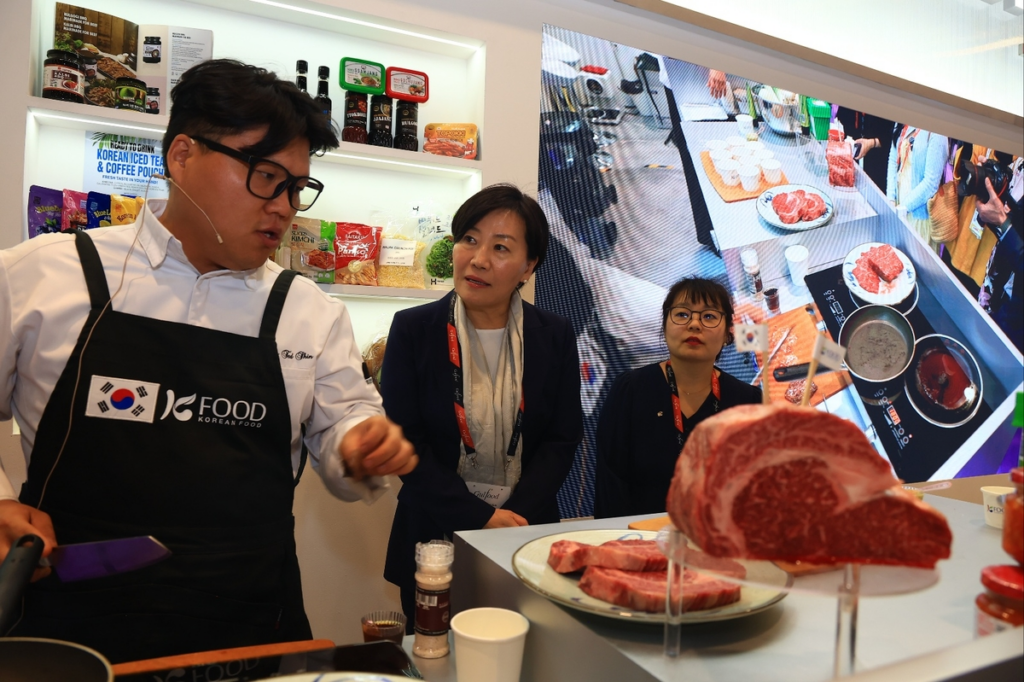
Minister Song also visited Gulfood 2026, the largest food exhibition in the Middle East and Africa, to encourage Korean exporters participating in the event. She reviewed halal-certified Korean beef promotions aimed at influencers and consumers, while also assessing trends and consumer preferences in the halal food market.
Gulfood 2026, an international food exhibition with a history spanning over 40 years, saw participation from approximately 8,500 companies from 195 countries this year—more than double the scale of the previous year. Korea likewise doubled the size of its participation by organizing an integrated Korea Pavilion featuring 24 companies. Processed food exporters specializing in sauces, beverages, and snacks, along with integrated organizations representing fresh agricultural products such as strawberries, grapes, and kiwifruit, actively engaged in buyer consultations and promotional activities to expand their presence in the Middle Eastern market.
K-Food: A Gateway to the Korean Experience
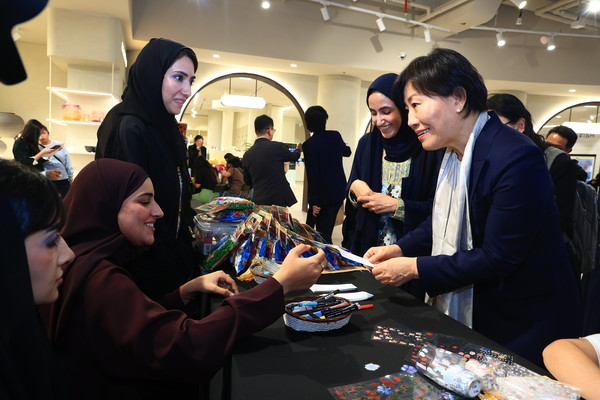
Minister Song also hosted an experiential K-food promotional event linked to the K-Initiative at “Korea 360.” Titled “K-Food: A Gateway to the Korean Experience,” the event was designed to allow local consumers to experience K-food alongside Korean culture—including K-pop, fashion, crafts, and the Korean language—at each booth.
Six related organizations participated in the event, including the Korea Agro-Fisheries & Food Trade Corporation (aT), the Korea Creative Content Agency, the Korean Cultural Center, and the King Sejong Institute, each representing different areas of the K-Initiative in the UAE.
On the main stage, ten pre-selected teams took part in the “Black & White Masters of Gimbap” competition, where participants learned how to make gimbap from local Korean chefs and showcased their own creative gimbap and pairing sauces. The main ingredients included halal-certified Korean beef bulgogi and stir-fried kimchi, along with a variety of Korean seasonings such as assorted vegetables, sesame oil, gochujang, and ssamjang.
Fatima, the winner from the Black Team, said, “I have loved Korean food since I was young and enjoy making it myself. Using halal-certified Korean beef bulgogi and stir-fried kimchi as fillings, and brushing sesame oil and bulgogi broth onto the seaweed, made it especially delicious.” Abdullah, the winner from the White Team, shared that he had been exposed to Korean food through Korean dramas since childhood, and credited his victory to “using a generous variety of fillings.”
Listening to Honest Feedback Through a K-Food Supporters’ Roundtable
At a local Korean restaurant, Minister Song held a roundtable meeting with K-food supporters, including members of a Korean culture club at Ajman University and members of the Top Club. The main dishes featured halal-certified Korean beef, with chefs highlighting its distinctiveness and quality. A wide variety of dishes—including grilled beef, marinated short ribs, various types of kimchi, and stews—were served, drawing enthusiastic responses from participants.
During the meeting, Minister Song listened to supporters’ candid opinions on their experiences with K-food, including what sparked their interest in Korean cuisine and the K-food items they most frequently enjoy.
Minister Song stated, “With halal food consumers accounting for 25% of the global population, the government views halal food as a strategic export diversification item. We will further strengthen support for halal certification, expand overseas logistics infrastructure, and enhance K-Initiative-linked marketing to promote premium K-food exports such as halal-certified Korean beef, strawberries, and grapes. At the same time, through strengthened cooperation with the UAE government in smart farming, agricultural technology R&D, and K-halal food as part of food security cooperation, we will continue to actively support the overseas expansion of Korean companies.”